SpaceX’s Acquisition Option on Cursor
On April 21, 2023, The New York Times reported a significant development in the tech world: SpaceX has secured a $60 billion option to acquire Cursor later this year. According to SpaceX’s announcement on X, the two companies will collaborate on GPU computing power.
This is not a traditional acquisition announcement but a rare business structure. Elon Musk has exchanged computing power for a “preemptive purchase option” on Cursor, with a high exit cost—if SpaceX ultimately chooses not to exercise the option, it must pay Cursor $10 billion as compensation for the collaboration.
$60 Billion Purchase Option
The origin of this deal stems from a GPU transaction. The Colossus supercomputing system under xAI possesses approximately 200,000 NVIDIA GPUs and plans to provide several thousand of them to Cursor for training its next-generation self-developed model, Composer 2.5.
This marks the largest third-party computing power collaboration in the AI programming field to date and represents xAI’s first attempt to turn computing power into a cloud service after its integration with SpaceX.
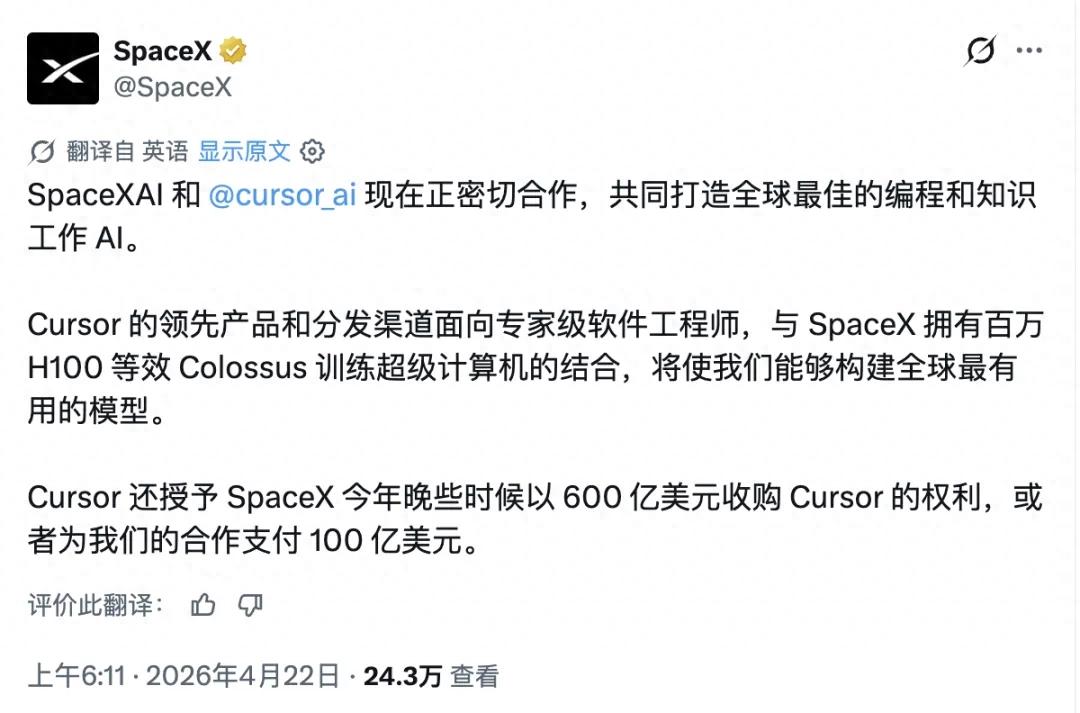
However, behind this GPU transaction lies the more critical term: the acquisition option. The cleverness of this structure is that it is not legally an acquisition, thus avoiding antitrust scrutiny; yet, it makes Cursor’s independent path extremely costly. Exercising the $60 billion option or forfeiting and paying $10 billion—either outcome deeply binds Cursor to Musk’s strategy.
At the same time, Cursor is pursuing a new funding round of at least $2 billion, with a valuation exceeding $50 billion. a16z and Thrive Capital are expected to co-lead the investment, with Nvidia also participating, and this round is nearly oversubscribed.
While promoting independent financing and soaring valuations externally, Cursor quietly handed over the acquisition option to Musk. The simultaneous occurrence of these two events is hard to dismiss as mere coincidence.
Cursor Faces Challenges
To understand why Cursor agreed to this deal, we need to look at its current struggles. Over the past year, discussions about “Cursor is dead” have never ceased. An investor in Cursor revealed to Fortune that several startups in his portfolio are migrating away from Cursor. Fortune’s cover story in the April-May 2026 issue directly stated that Cursor faces an “innovator’s dilemma”—having created the AI programming sector, it may now be eliminated by the market it helped to ignite.
Zach Lloyd, CEO of competitor Warp, pointedly remarked, “I don’t believe the meme that ‘Cursor is dead,’ but ‘IDE is dead’ is true. Software is no longer built that way.”
The previous paradigm was “Cursor = IDE, Claude Code = terminal,” but this notion has been outdated since January 2026. Claude Code can now run in VS Code, JetBrains, desktop applications, and browsers, while Cursor has also launched CLI and Agent modes—both companies have invaded each other’s territories.
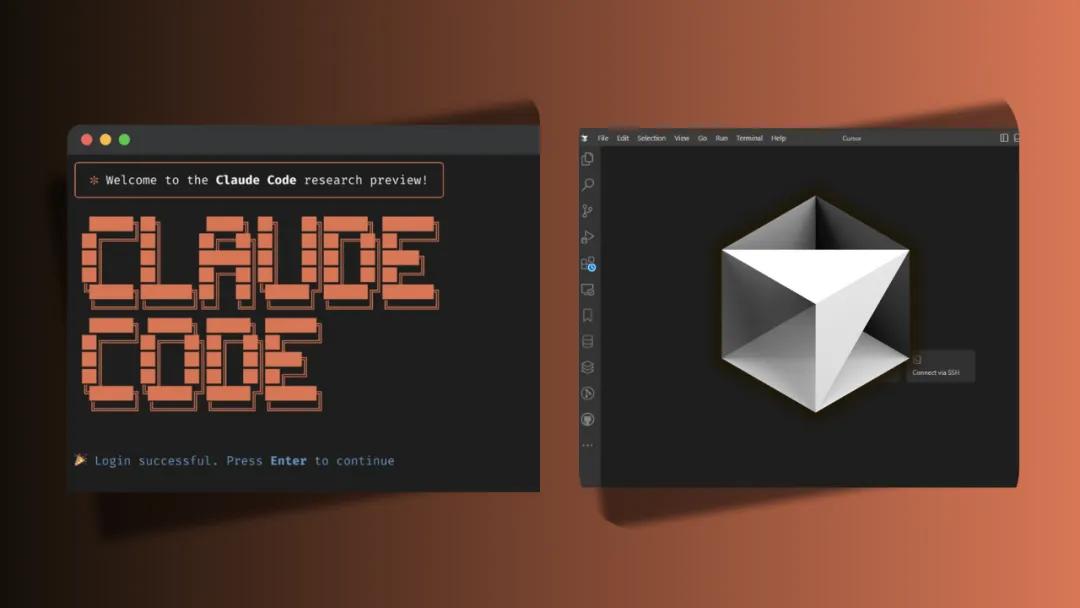
The rapid rise of Claude Code has caught the entire industry off guard. By early 2026, Claude Code’s annual revenue had reached $2.5 billion, with over 300,000 enterprise clients, making it one of the most valuable assets in Anthropic’s valuation system.
Adding to Cursor’s troubles was a serious “scandal.” In January, Anthropic discovered that xAI engineers were using Cursor to access Claude models to accelerate internal development. Anthropic subsequently restricted Cursor’s access to certain Claude model features, citing a violation of the commercial terms prohibiting use for training competing products. xAI co-founder Tony Wu had to inform employees in an internal memo: “I believe many of you have noticed that the Anthropic model is no longer accessible on Cursor.”
The irony is that while Cursor was restricted, it was xAI that violated the rules—resulting in significant damage to Cursor’s carefully maintained image as a “neutral platform” within the developer community. Tech commentator Ed Zitron stated, “This incident directly harmed Cursor—one of Anthropic’s largest API clients—and sent a signal to everyone: any client in competition with Anthropic faces the same risk.”
Meanwhile, Cursor’s pricing issues have continued to escalate—after switching to a power-based billing model, developers reported monthly costs exceeding $1,400; a severe bug in March also caused silent reversion of submitted code changes, leading to actual engineering losses.
Musk’s Strategy of Erosion
From the perspective of SpaceX/xAI, this option agreement is merely the latest step in a broader strategy. Over the past few months, Musk’s infiltration of Cursor has been systematic: in March, he poached two core product engineering leaders from Cursor, Andrew Milich and Jason Ginsberg, who now report directly to Musk; in April, he signed the GPU computing collaboration agreement while securing the acquisition option. Musk has not attacked directly but has advanced simultaneously on talent, computing power, and capital fronts.
Internal data from xAI indicates that its GPU system’s model power utilization (MFU) is only about 11%, while the industry standard ranges from 35% to 45%. A significant amount of idle computing power needs to be monetized, and a star client like Cursor can both consume that power and bring strategic value.
Some analysts believe this collaboration marks xAI’s strategic shift from “merely building models” to “providing cloud computing services,” positioning it to compete with Amazon, Microsoft, and Google in the cloud services arena.
$60 Billion: An Endpoint or a Starting Point?
The figure of $60 billion is supported by Cursor’s actual business performance. The company predicts that by the end of 2026, its annual revenue will exceed $6 billion, implying it needs to triple its revenue in the next ten months. Its self-developed model Composer 2 has improved by about 37% in programming benchmark tests compared to its predecessor, with inference costs significantly lower than comparable models.
However, Cursor is acutely aware that its independent path is becoming increasingly difficult. When Anthropic can cut off model access at any time, when Claude Code is directly encroaching on IDE territory, and when OpenAI’s Codex is also closing in, the survival space for a “neutral AI programming IDE” is being systematically compressed.
The $60 billion acquisition option, from one perspective, resembles a “decent insurance policy.” Musk has provided Cursor with a certain exit ceiling, giving it a card to play in the uncertain independent race.
Yet, this card comes at the cost of placing its fate in another’s hands.
The era of IDEs in AI programming tools is coming to an end. Who will dominate the next era remains unanswered—but Musk has already secured a ticket to the front row.
Comments
Discussion is powered by Giscus (GitHub Discussions). Add
repo,repoID,category, andcategoryIDunder[params.comments.giscus]inhugo.tomlusing the values from the Giscus setup tool.